On May 22, members of Special Collections traveled to Western Regional Archives to attend the North Carolina Preservation Consortium (NCPC) workshop, Book Repair Basics: Practical Repairs for Library and Archives Collections. Sai Estep, Hannah Helmey, Kari Salisbury, and Celine Shay spent the day learning and practicing the basics of book repair, such as replacing spines, mending torn or missing pages, and reinforcing hinges.
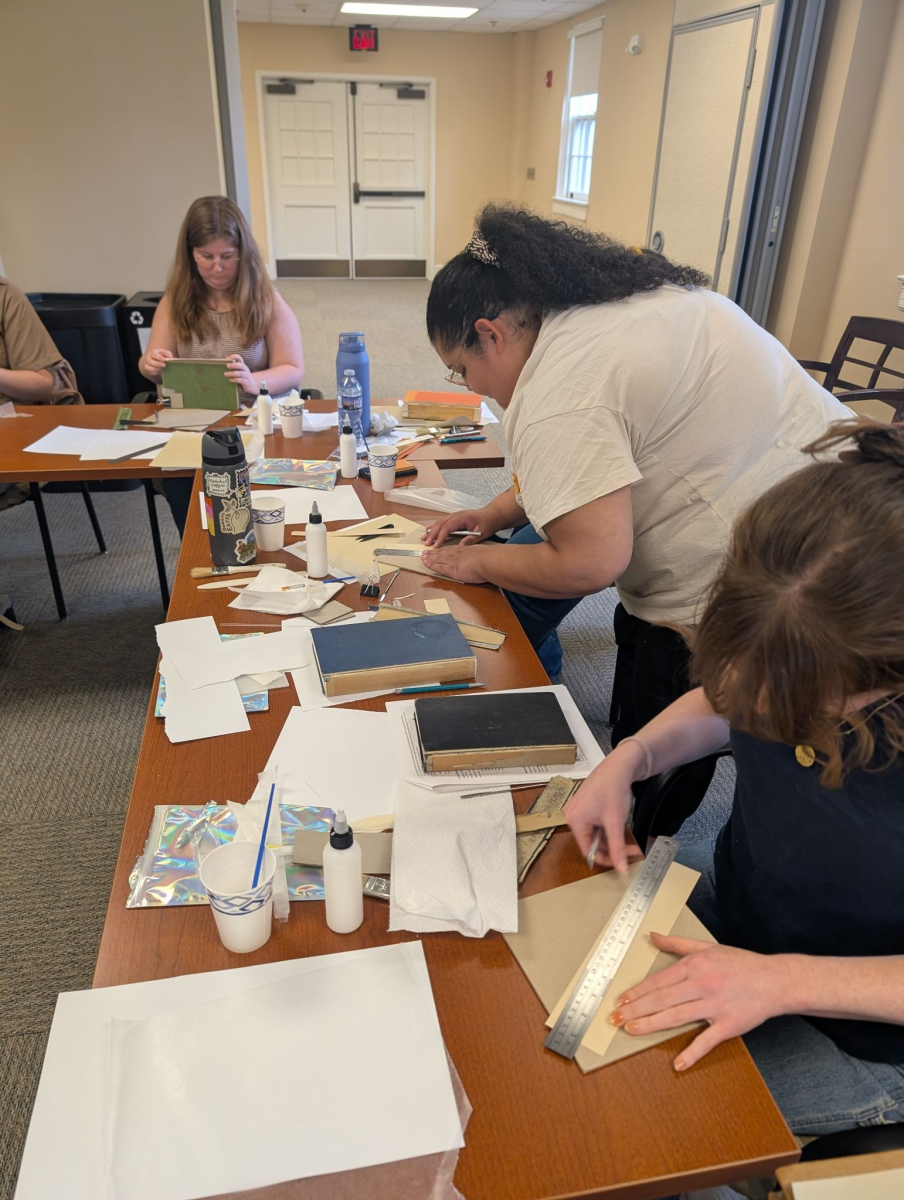
Celine Shay and Hannah Helmey working on spine replacements.
This workshop was facilitated by Gerald Ward, Assistant Director and Head of Archives & Special Collections at High Point University Libraries. Ward was trained by Don Etherington who was the owner and director of Etherington Conservation Services in Greensboro, NC. When he’s not working at HPU, Ward runs a private conservation studio where he utilizes his conservation skills. For the workshop, he equipped participants with books and supplies for the event, and explained that the practice of book repair is a blend of art and science. Since the main goal is to preserve these objects for future use, it’s vital to mend books with materials that will not cause further harm, or quicken degradation. Conservation-quality or neutral pH items such as Japanese tissue and wheat starch paste are used for mending and adhesion.
The artistry of book repair is evident through the craftsmanship used in conservation work. Terms such as a “sympathetic mend” speak to the care that conservators take in restoring bound materials. They aim to not only keep them intact, but also as close to their original selves and with as little intervention as possible. Subtlety and a steady hand are necessary. Ward mentioned at one point that when he interviewed new employees in his previous position at a private company, he often looked for a background in arts and crafts, as these skills translate well to the dexterity and detailed work of conservation. He emphasized that one can be a great potential conservator on paper by knowing the science involved, but might struggle with the actual delicate nature of the work once in the lab. The exercises in the workshop made it clear that successful conservation is reliant on practice more than a formal degree.
This type of workshop is valuable for receiving the hands-on experience necessary to practice these skills. Participants were also given the chance to bring a personal book for repair advice. Hannah brought in a family heirloom, an antique copy of The Complete Woodcuts of Albrecht Dürer, and Sai brought in a very different specimen–a beach-worn and battle-weary paperback copy of House of Leaves, by Mark Z. Danielewski. Gerald was gracious in his expert assessment, and gave both of them sound advice for how to approach repairing these items.
While this type of repair is best suited for circulating, non-rare items, this class gave the team an understanding of the level of expertise involved in conservation. For rare books, referring to a professional conservator is recommended, but the basic repair skills acquired from this workshop can be used to stabilize general books that need to get back on the shelves and into the hands of patrons.
- Submitted by Sai Estep, Manuscripts and Archives Processor

