
Friday, May 15th, marked the end of my term working as a Graduate Assistant in Belk Library’s Special Collections Research Center this Spring, and I am left with a great appreciation for the value that this experience has afforded me. Surprisingly, I never visited Special Collections during my undergraduate education at Appalachian State. Now, I’d feel something of an obligation to recommend a visit to any student who is unaware of the resources offered here, not to mention the availability of (in my opinion) the best views of campus to take in while you work or study.
My position in Special Collections was somewhat rotational, an aspect of the experience that I grew to appreciate. Week by week, I typically had different responsibilities and assignments that provided new learning opportunities; glances into the different parts of library and archival processes. A particularly memorable experience this semester was getting to assist in the advertising, set-up, and presentation of Special Collections’ Second Rhinehart Rare Book Room Open House, which was held on March 2nd. Additionally, I assisted in visiting class sessions from the English and History departments, created promotional materials for our collections, processed collection materials, shelved in the closed stacks, and much more.
Puzzle Loan Project:
A responsibility that ended up becoming one of my favorites was our puzzle loan project, in which Special Collections loans out historical photographs of Boone and Appalachian State in puzzle format to be enjoyed and solved by anyone wandering through our campus. You may have seen, or worked on, some of our puzzles that can be found in both the 1st and 4th floors of Belk Library, Anne Belk Hall, Plemmons Student Union, and the Erneston Music Library. Public Services Lecturer Librarian Hannah Helmey and I routinely checked locations, exchanging solved puzzles for new ones upon completion.
Although the actual work of this process was simple, something about the project itself feels deeply important. To me, there is endless value in a collaborative project such as this, for which participation requires nothing but curiosity and a few minutes of your time. Finding a solved puzzle always made me proud of our Appalachian State community.
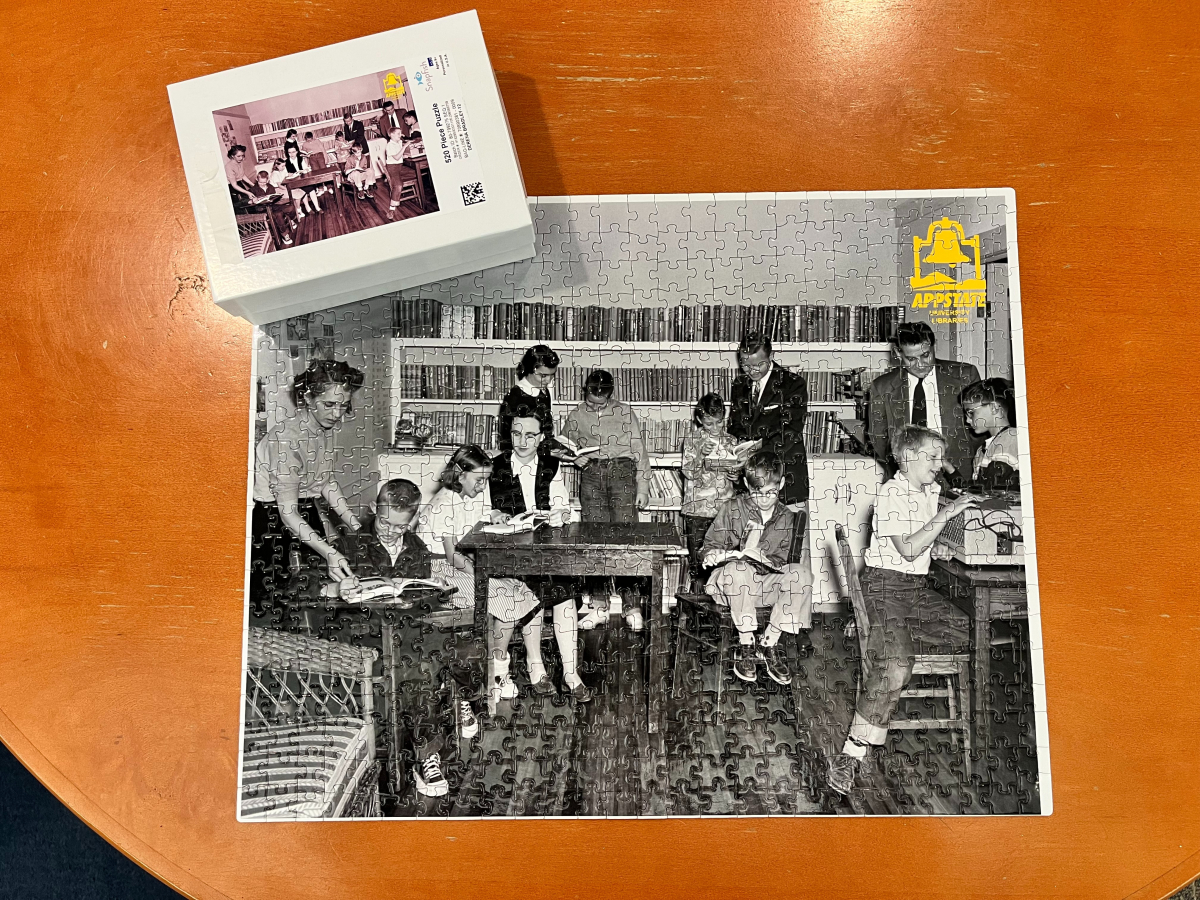
A completed puzzle on the first floor of Belk Library. (Reading Clinic 1956), puzzle completed May 15th, 2026.
Metal-Bound Tanglewood Tales
Something I came to appreciate more and more during my assistantship was the sheer volume of beautiful book covers that can be found in our collections. For a quick overview of some of the highlights, take a look at this 2017 blog post by former student assistant Liv Winnicki.
In addition to book covers that are visually pleasing, Special Collections also holds a few volumes that are bound in rare, unique styles. A standout item that I came across in January is this copy of Nathaniel Hawthorne’s Tanglewood Tales (1853). Special Collections’ John and Marjorie Idol Nathaniel Hawthorne collection contains many striking covers throughout its array of Hawthorne’s work, but this book is contained in an uncommon metal binding. If you would like to see this book in person, it can be viewed by appointment.
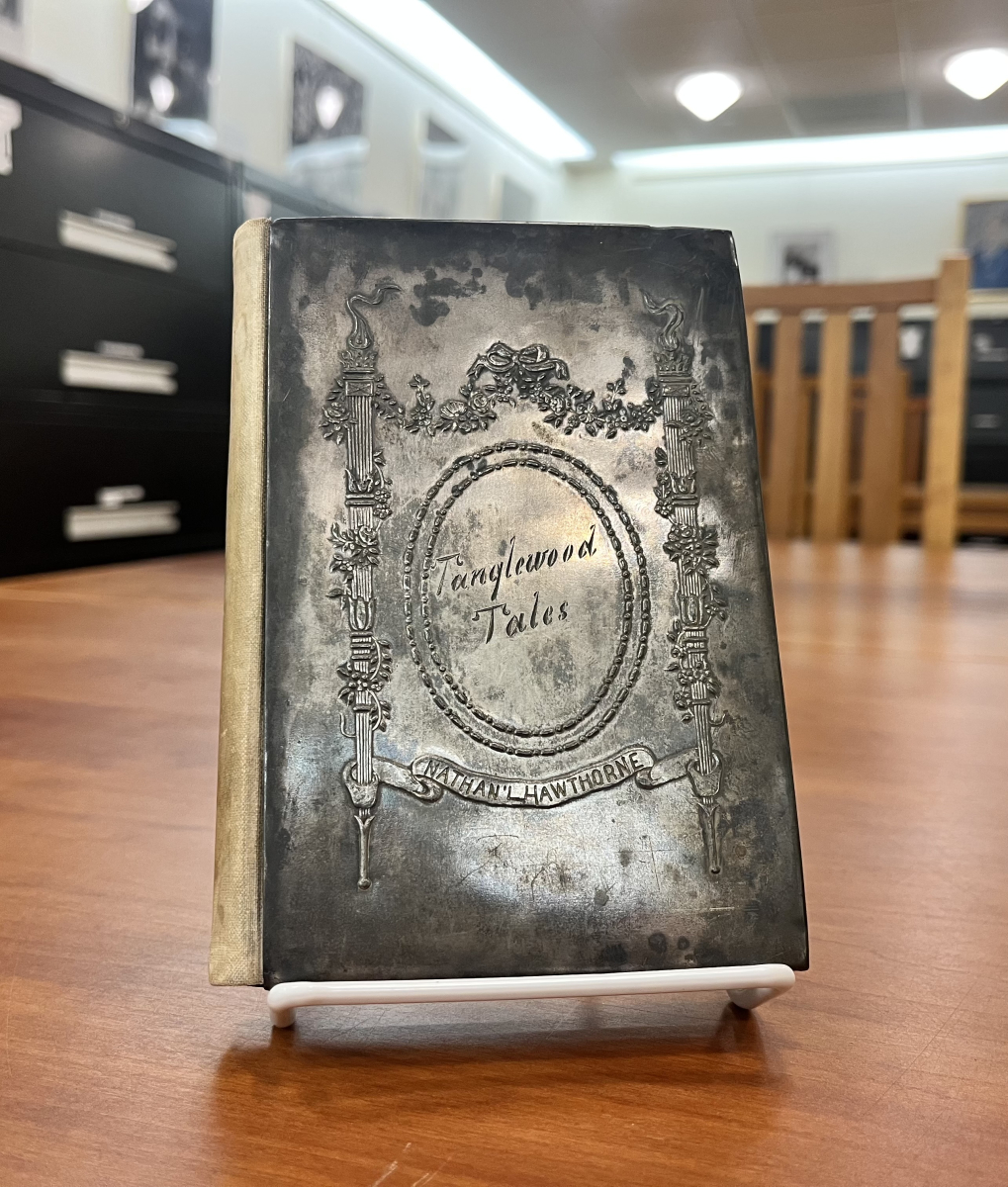
Tanglewood Tales, Rare Stacks PS1869.A1 1800ze Additional information about this copy is somewhat sparse, but thanks to Public Services Assistant Kari Salisbury, I found out that a series of books in this style were published by the Merriam company in the late 1800s. According to the Lucile Project of the University of Iowa, these books were “Bound in a cream or tan cloth, both boards overlaid with stamped metal plates; metal has not yet been identified but may be silver or pewter.” Below is a copy of Owen Meredith’s Lucile that was created in the same fashion as this unique copy of Tanglewood Tales.
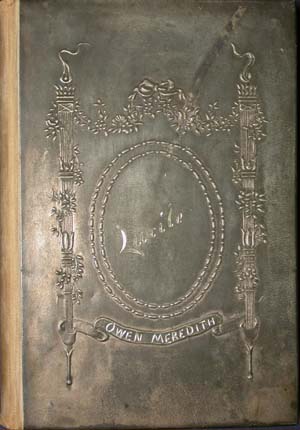
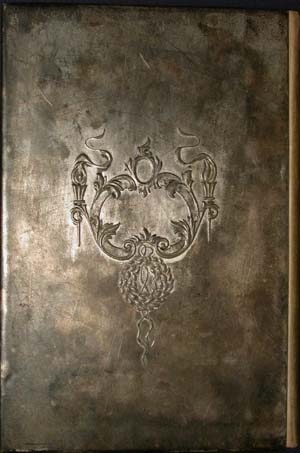
Source: https://sdrc.lib.uiowa.edu/lucile/publishers/merriam/merriam.htm
Mystery Item in the George Flowers Photographs Collection
The George Flowers Photographs Collection consists of approximately 50 linear feet of images created by local photographer George Arthur Flowers Jr., August 13, 1923 - January 15, 2008. Born in Catawba County, Flowers was a radio technician, World War II Navy veteran, Purple Heart recipient, and photographer. In 1958, Flowers purchased and began operating his photography shop on West King Street after the previous owner, Palmer Blair, died tragically in a small plane crash.
In 1998, Flowers donated his collection of photographs to the Boone Area Chamber of Commerce, with his 2008 obituary stating his wish that his collections would be “available to local people and area businesses.” In the early 2000s, water and sewage leaks at the Chamber of Commerce’s Howard Street facility damaged many photographs, causing the collection to be transferred to other locations for safekeeping, essentially being split in half. Much of the studio portraiture section was donated to the Special Collections Research Center, while the remaining materials were stored in the Chamber’s new facility until a 2017 partnership with Digital Watauga allowed for this portion of the collection to be digitized and made available to the public. While the studio portraiture section that we house here at Special Collections is yet to be completed and made publicly available, you can view a portion of Digital Watauga’s collection of Flowers’ work at this link. SCRC’s portraiture portion is expected to be completely processed by the end of this summer, and its finding aid published for researchers.
Throughout the Spring semester, I spent somewhere in the ballpark of 60 hours processing a portion of the George Flowers Photographs Collection. While the majority of items within this collection are portraits; families, babies, newlyweds, and more, I stumbled upon a particularly interesting folder while processing this collection. Pictured below is a piece of jewelry, possibly a pin or brooch, meticulously detailed and styled in the shape of a spider. Additional research on who may have created this piece of art has yielded no results so far, but it stands as an example of the interesting discoveries that often arise in archival processes.
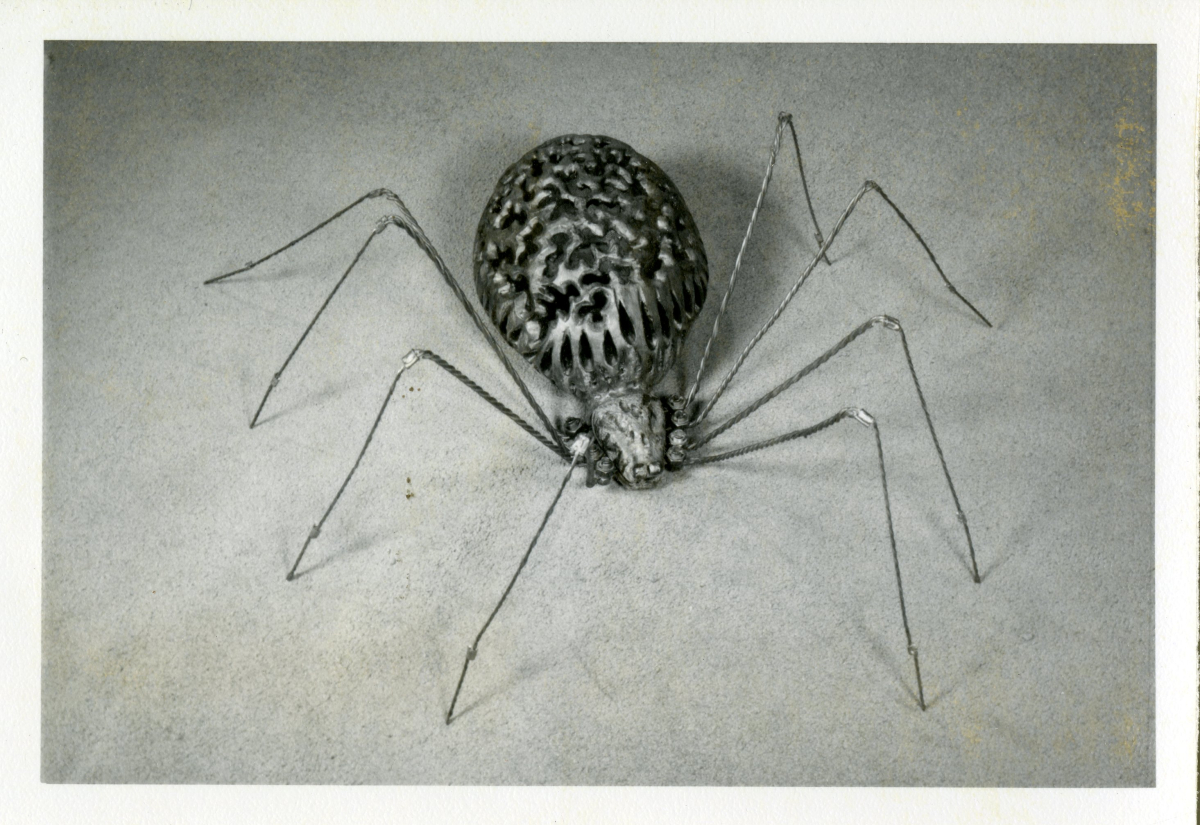
George Flowers Photographs Collection, AC. 1285
Conclusion:
I’ve heard that the 2005 construction plans of Appalachian’s Belk Library sought to design the Special Collections Research Center as the ‘crown jewel’ of the building: personally, I’ve found it to fit this criteria both physically and metaphorically. When the opportunity to work here landed at my feet, I was most excited for the resume experience I would gain. Now, after the conclusion of the Spring semester, I’ve found that working in Special Collections has provided me much more than just the on-paper experience. Perhaps most importantly, my interest in the past, present, and future of Boone, Appalachian State, and Western Carolina as a whole feels like it’s been set on fire. I think the passion I have for archival work was always there, it just needed a spark.
To play even just a small role within the massive system of information that makes up a library has been enlightening, something I view as the most important academic experience I’ve had in my four years at Appalachian State. I want to offer my sincere gratitude to all those who I’ve had the pleasure of working with this Spring, and I hope to be back in the Fall semester. If you have yet to step through the door of the Special Collections Research Center, like me, prior to this semester, give it a try when you can. You may make some discoveries of your own.
- Contributed by London Fowler, Graduate Student Assistant
Sources:
Digital Watauga George Flowers Collection:
https://digitalwatauga.org/collections/show/21
John and Marjorie Idol Hawthorne Collection:
Liv Winnicki’s Post:
Lucille Project:
https://sdrc.lib.uiowa.edu/lucile/publishers/merriam/merriam.htm
Rhinehart Room Open House Post:
https://collections.library.appstate.edu/news/second-rhinehart-rare-book-room-open-house-held-32
Tanglewood Tales Search Link:

A close-up, black-and-white studio photograph showing the underside construction details of the mechanical spider. The image reveals metal plates, small hexagonal nuts, and wire attachments used to construct the legs and attach them to the body. A separate, textured, cast-metal piece—resembling a cephalothorax or head—lies detached on the surface below the main assembly.

Merchanical spider from the George Flowers Photographs Collection, AC. 1285